Jhargram Elephant Conservation

Elephant Conservation Program For promoting Human-Elephant Coexistence

South West Bengal (SWB) is one of India’s major hotspots for human-elephant conflict, characterized by a distressing number of both human and elephant fatalities despite the region being inhabited by only 180-200 elephants.

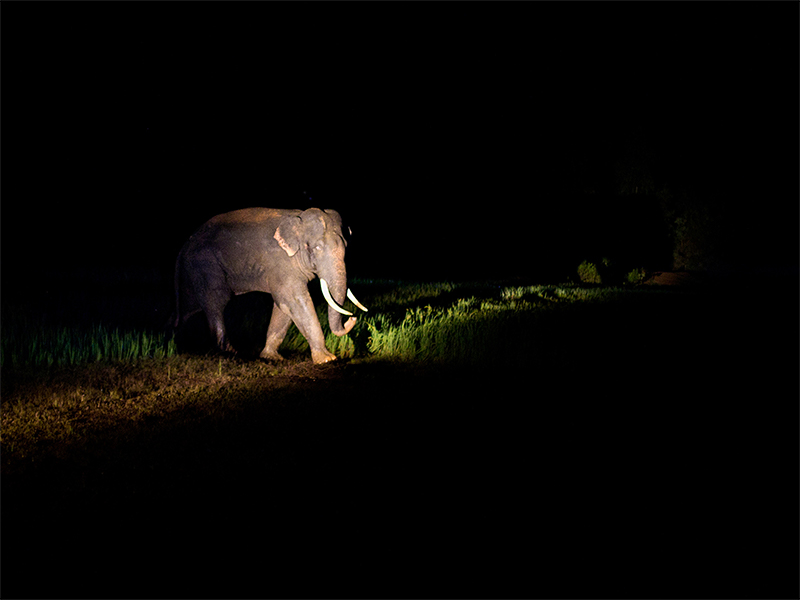
This conflict primarily persists due to SWB’s dry landscape, which lacks dense natural forests. Islands of teak plantations exist among a sprawling matrix of agricultural land and human settlements. To survive, elephants seek refuge within these plantations during the day, which lack plants that typically comprise an elephant’s diet in the wild. At night, these elephants come out of hiding and raid paddy fields or even people’s houses to fulfill their nutritional needs.

The crop loss, property damage, and, in extreme cases, human deaths caused by elephants intruding into paddy fields and villages lead to immense financial and emotional distress. Such financial losses rarely get compensated, leading to gradual impoverishment. Over time, the economic hardships and constant threat to life engender antagonism towards elephants within local communities.

An elephant herd inside a teak forest in SWB’s Bankura district (credits: Amit Modak)

Hostile village youth agree to participate in state-sanctioned Hulla drives, a harrowing practice steeped in cruelty, often carried out to drive elephants out of paddy fields and villages. During these drives, fire-lit ‘mashaals’ or torches with spiked ends, are hurled at elephant herds, causing extreme physical injury and psychological distress. Such drives have also led to the accidental deaths of young calves that got separated from their herd.

House of residents from a village in Jhargram destroyed by elephants
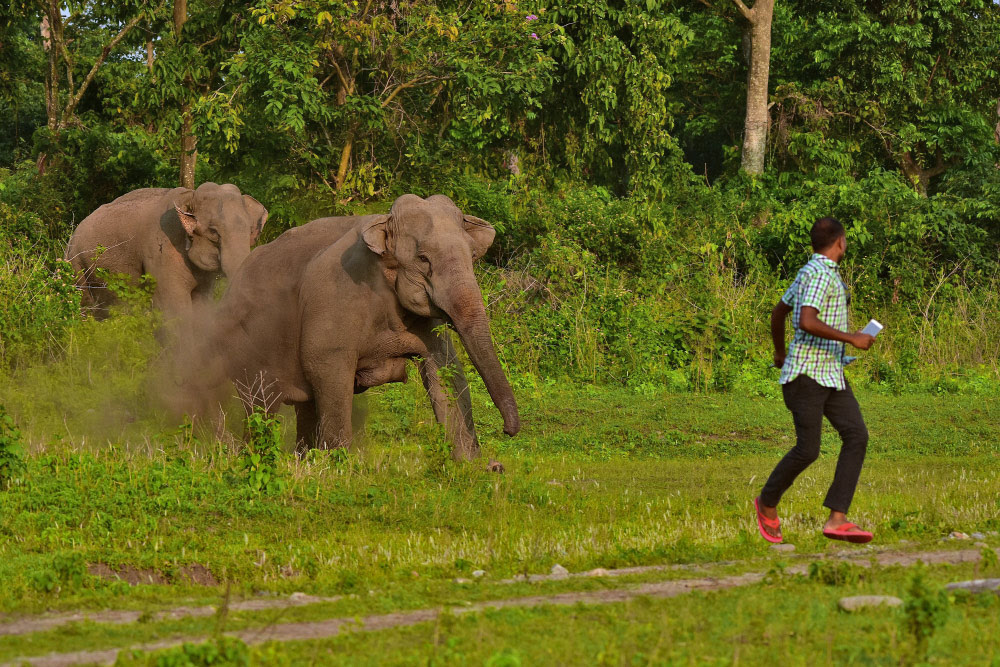
Elephants raiding paddy fields in Jhargram district, SWB, as villagers look on
Fire-lit torches being hurled at elephants during a hulla drive

The crop loss, property damage, and, in extreme cases, human deaths caused by elephants intruding into paddy fields and villages lead to immense financial and emotional distress. Such financial losses rarely get compensated, leading to gradual impoverishment. Over time, the economic hardships and constant threat to life engender antagonism towards elephants within local communities.

Hostile village youth agree to participate in state-sanctioned Hulla drives, a harrowing practice steeped in cruelty, often carried out to drive elephants out of paddy fields and villages. During these drives, fire-lit ‘mashaals’ or torches with spiked ends, are hurled at elephant herds, causing extreme physical injury and psychological distress. Such drives have also led to the accidental deaths of young calves that got separated from their herd.

To mitigate human-elephant conflict and promote elephant conservation in SWB, HEAL implemented a project in the Jamboni block of Jhargram district, with support from Coforge Ltd in early 2024. The project aims to address three key factors that drive negative interactions between humans and elephants:

  • Lack of fodder trees and nutritional sources for elephants
  • Threats to human-owned property and life
  • Inadequate compensation for crop loss

To achieve these goals, the project undertook the following activities:

1. Created exclusive sources of food for elephants by planting fodder trees and cultivating paddy exclusively for foraging by elephants

Sowing seeds to grow paddy
Paddy saplings being transplanted
Elephants feeding on the paddy cultivated by us
Seeds of tree species preferred by elephants being sown
Nursey housing the mature saplings of elephant fodder trees
A plantation drive engaging primary school students to transplant the elephant fodder saplings

2. Reduced elephant incursions into villages through the installation of solar fences

Solar fence installation in progress
Warning signs being fitted onto the solar fences
An installed solar fence

3. Provided in-kind compensation to farmers who had suffered losses due to depredation of their paddy fields by elephants

Our team surveying the crop damage caused by elephants
Compensation in-kind being provided to beneficiaries
Some of the beneficiaries of the first compensation drive

4. Organised trust-building exercises with the community and conducted year-round awareness programs to foster understanding and tolerance towards elephants

A routine awareness program for the residents of the project site
Our team conducting a seminar on human-elephant conflict at a local school in Jamboni
A football organised as part of the compensation drive

By taking these initiatives on a sustained basis, HEAL aims to foster a more harmonious coexistence between humans and elephants in South West Bengal.

My cart
Your cart is empty.

Looks like you haven't made a choice yet.